THORACOCENTESIS
Introduction
Thoracocentesis is the
name given to the clinical technique where by fluid or air is removed from thoracic cavity.
1. Thoracocentesis may be diagnostic to determine whether air or fluid is present and to characterize the nature of the fluid obtained.
2. Thoracocentesis also can be therapeutic when removing large volumes of air or fluid to allow pulmonary re-expansion and correction of hypoxemia and orthopnea.
3. Rapid stabilization in immediate respiratory distress due to the accumulation of air or fluid in the pleural space.
When the findings of
the thoracic auscultation or percussion are suggestive of pleural effusion then
thoracocentesis is performed to -
Ø To
Confirm the presence of pleural effusion.
Ø Provide
a specimen for examination which provide a diagnosis or
guide the therapeutic plan .
Ø Therapeutically
drain a large of pleural fluid is present.
Materials
needed:
Ø Sterile
Needle
Ø Cat,
18-23 gauge
Ø Dog,
18-21 gauge
Ø Scalp
Vein
Ø
A
flexible polythene catheter with removable needle
Ø
Syringe-
Usually 10-30ml so that large volumes of fluid/air can be collected.
Technique
1. Clip the hair and clean the skin at the proper location and each rib marked with an overlay of red ink.

2. Palpate the 13th rib, and then the 12th interspace immediately in front of it.‘Walk’ your fingers cranial ly from one interspace to the next, counting 11-10-9-8-7 as you go, to identify the 7th and 8th interspaces.

3. Once
you’ve identified the desired location, advance the needle through the skin.
As soon as the needle enters the subcutaneous space, pull back on the plunger to apply 1-2 cc’s of vaccum. You should be able to feel the
plunger tugging against your fingers.

4. Never advance the needle deeper than you think the pleural space is your main goal is to avoid lacerating the lung in animals that in fact have no pleural space fluid or air.
5.Withdraw the needle as soon as you get a positive tap (loss of vacuum observation of fluid), and proceed to a therapeutic tap.
6. While maintaining a strong suction, advance the needle through the chest wall at the leading (cranial) edge of the rib behind it. The instant the needle enters the pleural cavity , you will either lose the vacuum (in the case of pneumothorax as shown here) or observe the entry of fluid into the needle barrel (in the case of pleural fluid accumulation).
1. Clip the hair and clean the skin at the proper location and each rib marked with an overlay of red ink.

2. Palpate the 13th rib, and then the 12th interspace immediately in front of it.‘Walk’ your fingers cranial ly from one interspace to the next, counting 11-10-9-8-7 as you go, to identify the 7th and 8th interspaces.

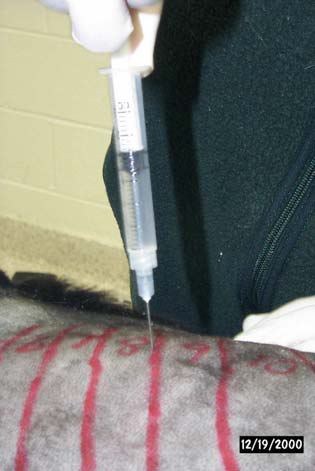
4. Never advance the needle deeper than you think the pleural space is your main goal is to avoid lacerating the lung in animals that in fact have no pleural space fluid or air.
5.Withdraw the needle as soon as you get a positive tap (loss of vacuum observation of fluid), and proceed to a therapeutic tap.
6. While maintaining a strong suction, advance the needle through the chest wall at the leading (cranial) edge of the rib behind it. The instant the needle enters the pleural cavity , you will either lose the vacuum (in the case of pneumothorax as shown here) or observe the entry of fluid into the needle barrel (in the case of pleural fluid accumulation).


Fluid
Analysis
EDTA tube
a. Total protein concentration
b. Specific gravity
c.Total nucleated and red cell counts, and cytology.
Plain tube
a. Bacteriological examination
b. Other biochemical tests e,g, triglycerides and cholesterol
c. Smears should be prepared immediately after collection.
Type
of effusion
1. Pure transudate
a. Low protein level in the plasma (hypoproteinemia)
1. Pure transudate
a. Low protein level in the plasma (hypoproteinemia)
b. Congestive
cardiac failure
2. Modified transudate
a. High
venous and capillary hydrostatic presure
b. Congestive
heart failure
c. Obstruction
of vein and/or lymphatics –intrathoracic mass
3. Chylous effusions
a. Thorax
–rupture of the thoracic duct
b. Intrathoracic
lymphagiectasia
c. Obstruction
or trauma
4. Haemorrhagic exudates
a. Thoracic
trauma
b. Intrathoracic tumour
5. Exudates
1. Septic
a. Foreign body
b. Penetratign wound of the thorax, oesophagus or airway
a. Foreign body
b. Penetratign wound of the thorax, oesophagus or airway
2. Non-septic
a. Negative culture
b. Immune-mediated process
c. Parasitic or neoplastic process
Thoracocentesis is very effective and safe procedure in diagnosing conditions of the thoracic cavity in dogs and requires no special equipment. Thoracocentesis often makes the difference between life and death in dogs with severe disease.


